Context
Most social media management tools added AI as a button. AedahSocial was designed the other way round: every feature assumes AI is doing the first draft, and the interface is built around reviewing and refining rather than composing from nothing. It is scoped for every client type, from an individual or sole proprietor through influencers and small businesses to corporate and enterprise teams, across twelve industries, with multi-brand workspaces.
What was designed and built
Onboarding that configures the AI
A five-step wizard: client type, industry, platforms, AI provider, done. The provider step is the important one, see below.
The working surfaces
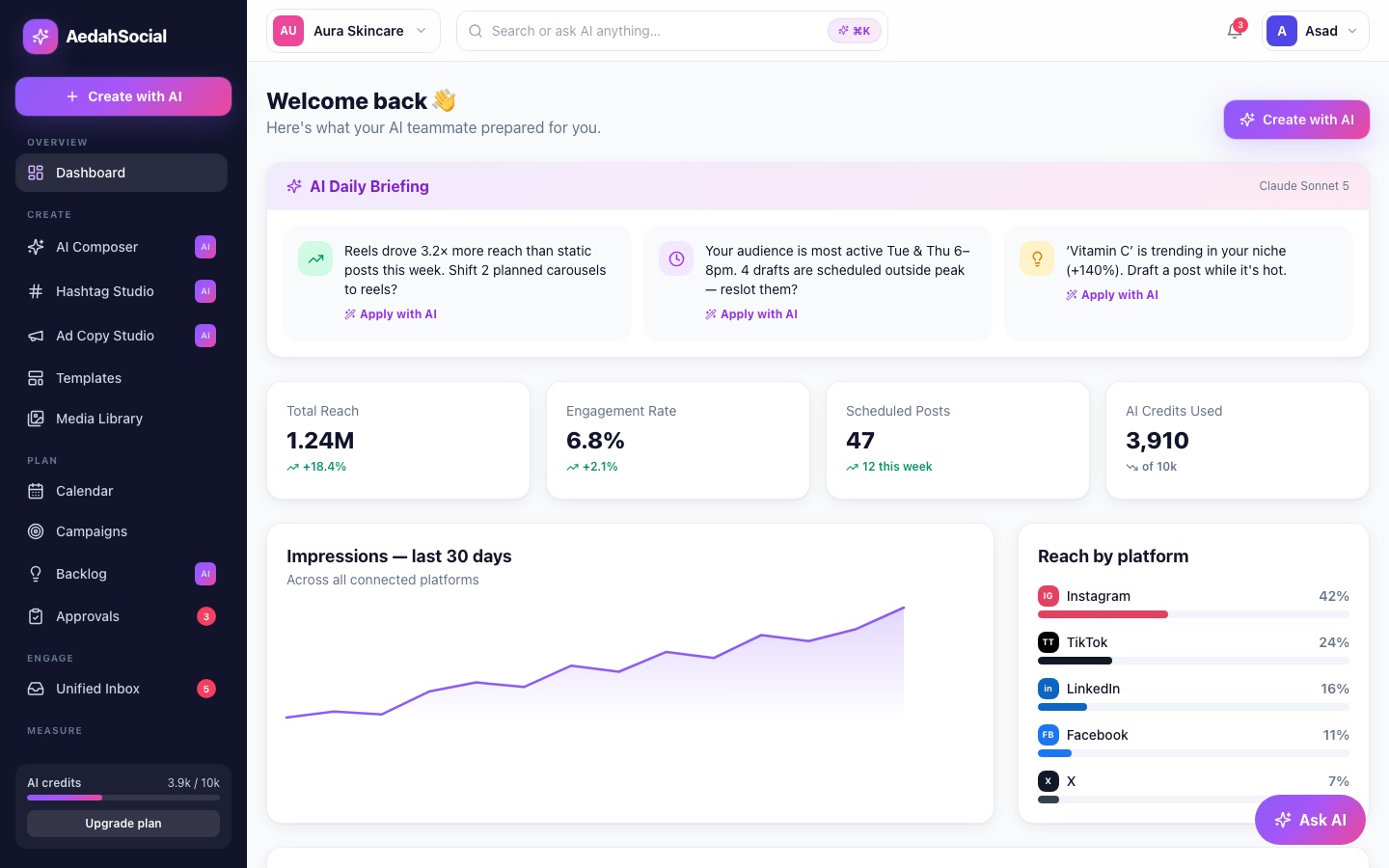
- Dashboard. An AI daily briefing, KPIs, an engagement chart and upcoming posts.
- Composer. A brief in, a platform-tailored post out, with a live preview and one-click refine actions.
- Calendar. A month view with an AI content planner and best-time-to-post suggestions.
- Hashtag Studio. Hashtag sets grouped by reach, niche and low competition.
- Ad Copy Studio. Three AI-scored ad variants for Meta and TikTok.
- Analytics. An AI-written performance summary above the metrics and top posts.
- Inbox. A unified inbox with AI-suggested replies.
- Brands. Multi-brand and multi-client workspace cards.
- Settings. Bring-your-own AI keys, per-feature model routing, and brand voice.
The decision that matters
Bring your own AI keys, routed per feature. Instead of locking the product to one AI vendor and marking up its cost, the user connects their own provider keys and can route each feature to a different model: a cheap fast model for hashtags, a stronger one for long-form ad copy. It is the same provider-agnostic instinct that runs through Nokhba.ai's live AI layer, applied here at the product-design level. It changes the business model (the product sells workflow, not tokens) and it is a genuinely non-obvious choice in this category.
Why it is in the portfolio
Range. This is product and interface design for an AI-native SaaS, with a real point of view about how such a product should be priced and architected, presented honestly as a prototype rather than as a shipped platform.