Context
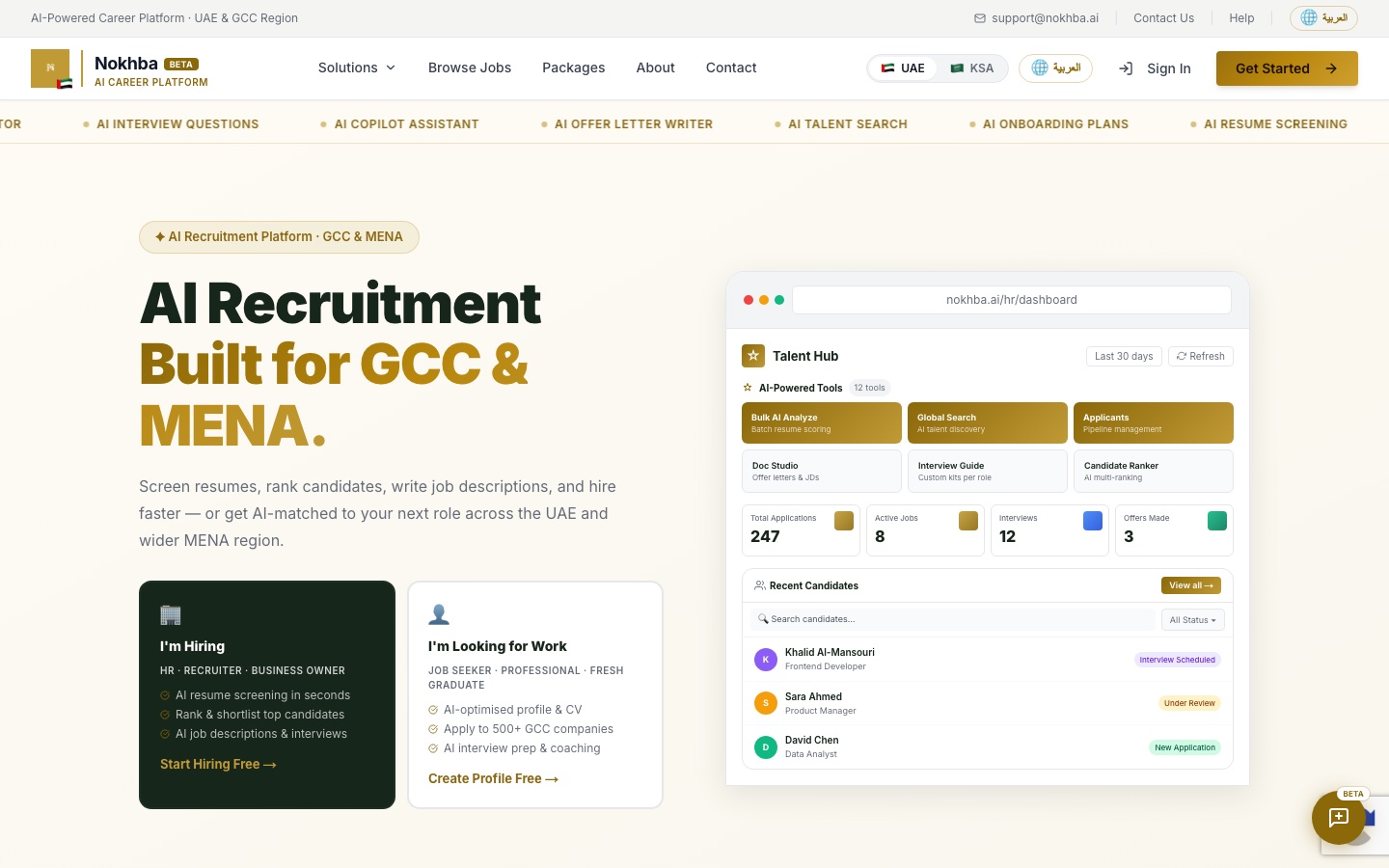
Nokhba (نخبة, "the elite") is a career platform for the Gulf and wider MENA market: Arabic-first with a full English experience, and switchable between the Saudi and UAE markets from the header. It serves two sides. Candidates get AI tools for the job search: a resume builder, a resume analyzer that scores and improves an existing CV, mock interviews with scoring, job alerts and application tracking. Employers and HR teams get job posting, bulk candidate screening and an enterprise tier. I built the whole thing, deployed it, and operate it.
What distinguishes it from the usual "AI resume tool" is how much of the operating business is actually implemented rather than mocked. The description below is taken from the backend's models and services, not from the landing page.
What I built
The candidate side
A resume builder with templates and version history, a resume analyzer, an "improve my resume" flow, and a full interview-preparation subsystem: mock interviews, an interview question bank, interviewer profiles, practice sessions and scorecards, with reminder jobs so a scheduled practice interview is not forgotten. Job search with categories, saved job alerts, and an application pipeline.
The employer side
Job posting with templates and categories, job expiry and expiry-reminder jobs so listings do not rot, bulk candidate analysis for HR teams screening many applicants at once, company pages, and an enterprise tier with its own entry point.
The business layer
Stripe for cards, with invoices, stored payment methods and a manual bank-transfer request flow for markets where card payment is not the default. A credit system that meters AI features: credit packages, credit transactions, and a low-credit alert job. Subscriptions with renewal reminders. A referral and commission system, so growth has a mechanism rather than a hope. Per-feature pricing so individual AI actions can be priced separately from plans.
Content and operations
Site content, announcements, FAQs and help articles are data, not hardcoded copy. Support tickets and consultation requests are first-class objects. Security events and security rules feed a structured audit log, and there is an encryption service for sensitive fields.
Architecture decisions worth noting
A provider-agnostic AI layer. The platform does not hard-wire to one AI vendor. There is an AI provider model, per-provider usage tracking, a dynamic AI service that routes requests, an initialiser that loads providers from configuration, a response cache, and a provider health service that watches for degraded vendors. I built it this way because a career platform in this market has to survive a vendor outage or a price change without a rewrite, and because it lets me price features by their real cost.
Cron as a first-class part of the product. Six scheduled jobs run the platform's lifecycle: interview reminders, job expiry, job expiry reminders, low-credit alerts, subscription reminders and job alerts. The product keeps working when nobody is looking at the admin panel.
My own QA discipline. There is a repeatable test suite with saved, phased results (phase 1, phase 1b, phase 2 and a cross-portal end-to-end pass), so a release is checked the same way each time rather than by clicking around.
Outcomes and evidence
- In production and publicly reachable at nokhba.ai, with Arabic and English and a KSA/UAE market switch on the live site.
- The full monetisation stack exists in code: payments, invoices, credits, subscriptions, referrals and commissions.
- Deployed and operated on a self-managed VPS, which is the DevOps half of the story: I own the server, not just the code.
Screenshot on this page is the live site.