Context
MindForge is a small assessment product: an operator creates quizzes, invites participants, and collects and reviews their answers. It needed to be quick for participants (no account creation) and simple to operate. I scoped it as a backend-first build with a clear API surface so that a web or mobile client could be attached without changing the server.
What was built
Quiz model
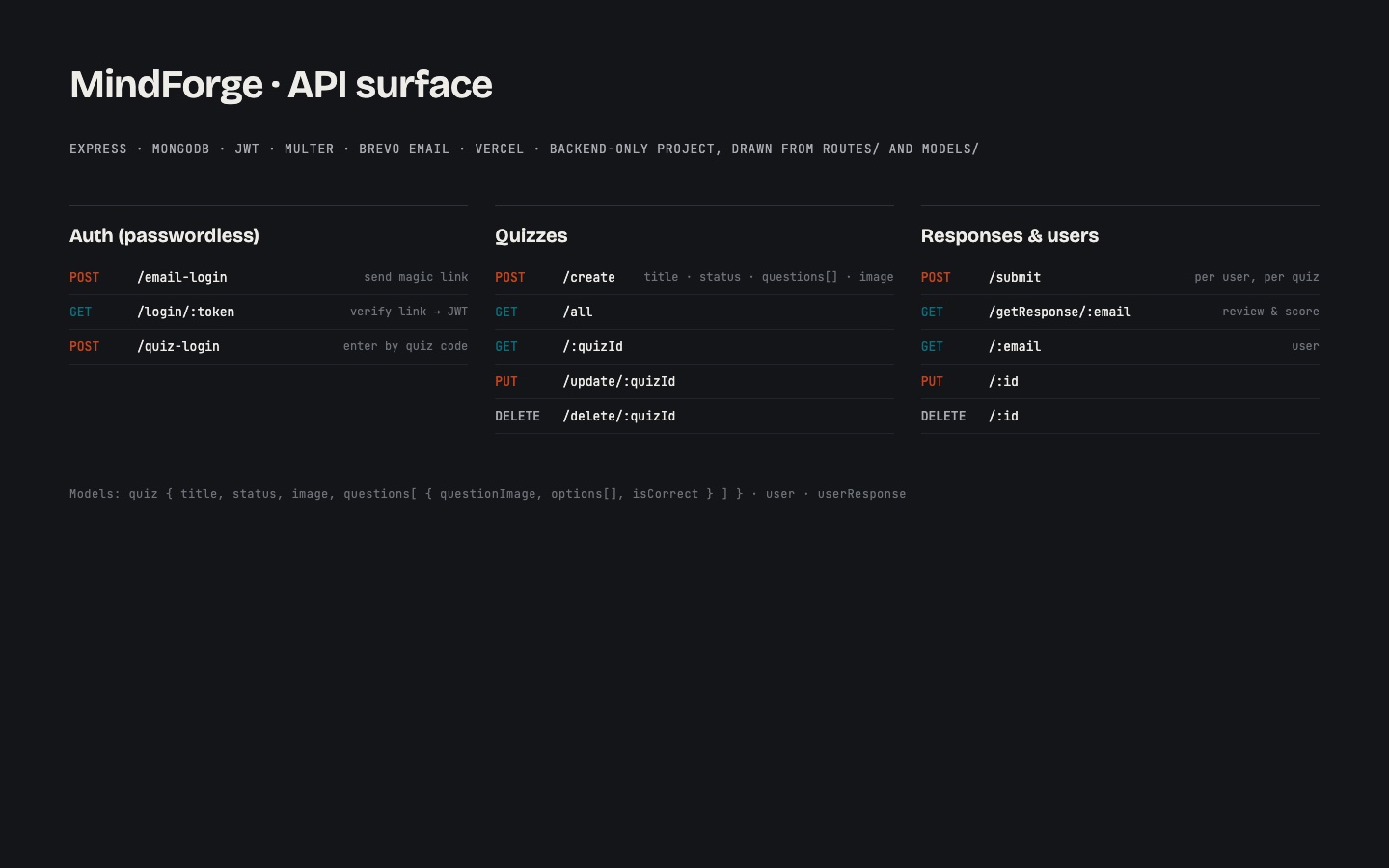
Each quiz has a title, status and an ordered list of questions; questions can carry an image, a set of options, and the correct answer, and the quiz itself can carry a cover image. Images are uploaded through Multer and served from the API.
Passwordless participation
Two entry paths: email login, which sends a one-time link that the API verifies by token, and quiz login, which admits a participant to a specific quiz by code. There are no passwords for participants to forget, which for an assessment tool is the whole point.
Response capture
Submissions are stored per user and per quiz, and can be retrieved by participant email for review and scoring. Quizzes can be created, listed, fetched, updated and deleted through a conventional REST surface.
Operational pieces
JWT-guarded routes for the operator, transactional email through Brevo with Nodemailer as fallback, server-side Canvas for generated images, and a Vercel deployment configuration so the API runs without a server to maintain.
Decisions worth noting
- Backend first, client later. Keeping the product as a clean API meant the client could be a web app, a kiosk, or a mobile app without touching the assessment logic.
- Remove the account. Magic links and quiz codes cost a little in engineering and remove the largest drop-off point in any participant flow.
Why it is in the portfolio
It is a modest, well-scoped team delivery that shows the same habits as the larger builds: a clear data model, a deliberately small surface, and an operator-friendly deployment. Presented at its true size.